

Why We Have Been Looking at Climate Change Through the Wrong End of the Telescope
An introduction to the book Excess Heat: Climate Change, Ocean Heat, and the Physics of Responsibility: Climate Change as a Thermodynamic System

Most people think of climate change in terms of images of smokestacks, carbon dioxide, melting glaciers, droughts, floods, wildfires, and stronger storms.
These images are familiar because they are real. They show us a planet under stress.
But they are not the problem.
They are symptoms.
The real problem is much more basic and, in many ways, harder to see.
The real problem is heat.
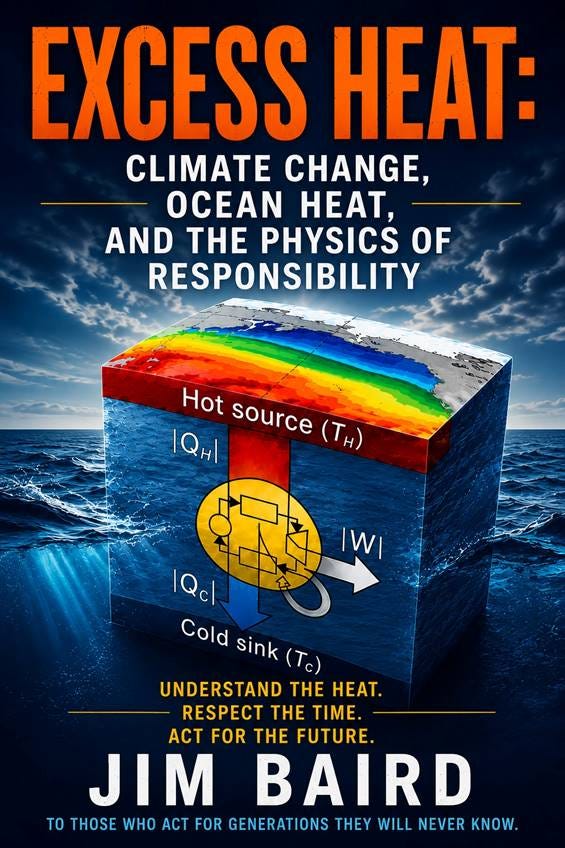
This idea is the basis of my new book, Excess Heat: Climate Change, Ocean Heat, and the Physics of Responsibility. The book argues that climate change is not mainly a problem of carbon emissions, economics, or politics. These issues are important, but they come second.
At its core, climate change is a thermodynamic problem.
The Earth is accumulating energy faster than it can release it.
Everything else follows from that fact.
For over thirty years, most climate discussions have focused on carbon accounting. We measure emissions, set targets, and make policies to reduce them. Carbon dioxide is now the main way we talk about climate change.
Yet carbon dioxide itself is not the thing causing harm.
Carbon dioxide is the mechanism.
Heat is the consequence.
Greenhouse gases do not create energy. They slow the rate at which energy leaves Earth for space. This creates a growing gap between the solar energy entering and the infrared radiation leaving.
Current estimates place Earth’s energy imbalance at roughly 0.7 to 1.0 watts per square meter.
That sounds tiny, less than the power used by a small LED light bulb spread over a kitchen table.
But Earth is not a kitchen table.
Earth’s surface covers approximately 510 million square kilometers.
But when you multiply that small imbalance across the whole planet, the result is huge.
The climate system is currently accumulating energy at a rate approaching 500 terawatts.
For comparison, the entire human economy, including every city, factory, aircraft, vehicle, ship, data center, power plant, and industrial process on Earth, consumes roughly 20 terawatts of power.
Put simply, the planet is warming more than 10 times faster than all of civilization’s energy use.
Pause for a moment and consider what that means: the electrical grid, global transportation systems, industrial manufacturing, the internet, artificial intelligence, and modern agriculture operate at roughly 20 terawatts.
Meanwhile, the climate system is absorbing about 500 terawatts of extra heat.
Every second.
This is not a small environmental issue.
It is a planetary-scale energy accumulation problem.
Scientists sometimes use the Hiroshima analogy to explain this. Each year, the extra energy entering Earth is like several Hiroshima-sized atomic explosions happening every second.
This comparison is not intended to be dramatic.
It is intended to be comprehensible.
It’s hard for people to picture terawatts and joules. We need comparisons to understand things on this scale.
The truth is, our planet is constantly absorbing huge amounts of energy.
Yet most of this heat remains invisible.
When people talk about climate change, they focus on air temperature because that’s what we feel. We notice heat waves, droughts, hurricanes forming, and wildfires and floods on TV.
But the atmosphere is not where most of the excess heat resides.
The oceans absorb more than 90 percent of the additional energy trapped by greenhouse gases.
This one fact changes everything.
Climate change is often described as a problem of atmospheric warming.
Physically speaking, it is primarily a problem of ocean heat.
The atmosphere responds quickly to changes in energy because it holds little heat. Oceans are different. Water can take in a lot of energy, but its temperature changes slowly.
The oceans cover more than 70 percent of Earth’s surface and average nearly four kilometers in depth.
They act as the planet’s heat reservoir.
Without the oceans absorbing this excess heat, atmospheric temperatures would already be dramatically higher than they are today.
In this way, the oceans have protected us.
But that protection comes at a cost.
The heat does not disappear.
It accumulates.
Some remains near the surface where it fuels stronger hurricanes, intensifies rainfall, drives marine heatwaves, and contributes to sea-level rise through thermal expansion.
Some penetrate deeper into the ocean where they can remain isolated from the atmosphere for centuries.
This brings up a key idea in the book: that operations operate on short timescales.
Businesses think in quarters.
Politicians think in election cycles.
Governments think in years.
Infrastructure planners think in decades.
The ocean operates on a timescale of centuries.
Heat transported into the deep ocean today may continue influencing the climate long after today’s governments, corporations, technologies, and economic systems have disappeared.
The climate system possesses memory.
This might be one of the most important, but least understood facts in the climate debate.
The consequences of emissions are not confined to the present.
They become part of the Earth’s physical system.
Energy added today continues moving through ocean circulation systems for generations.
This helps explain why climate change is so politically difficult.
The causes and effects are separated by time.
The damage is distributed globally.
The accumulating heat is largely invisible.
Human psychology is built to react to immediate threats, not to slow, energy-imbalancing processes that build up over centuries. The laws of physics do not care about human attention spans.
The energy remains.
Also, this extra heat does not just stay in one place.
It changes how the planet works.
Earth is not still. It is a system that constantly processes energy.
Heat is always moving around through winds, ocean currents, evaporation, storms, and radiation. Most solar energy enters the climate system in the tropics and then spreads toward the poles through air and ocean currents.
As excess heat accumulates, these flows change.
Warmer oceans increase evaporation.
A warmer atmosphere holds more moisture.
Storm systems gain access to larger energy reservoirs.
Ocean currents adjust.
Rainfall patterns shift.
Climate change is not just about the planet getting warmer. It is about how the planet’s energy flows are changing.
This distinction makes a world with more energy, not just a warmer version of what we know. It is a different system altogether. system.
Sea levels rise because warmer water expands and because additional heat melts land-based ice.
Storms become more intense because they can draw upon larger energy reservoirs.
Wildfires become more severe because heat alters soil moisture, vegetation, and atmospheric conditions.
Marine ecosystems shift because ocean temperatures change.
People often talk about these impacts as if they are separate.
But in reality, they are all connected.
They are just different signs of the same basic problem.
Excess heat.
That’s why the title of this book is intentional.
Climate change is often framed as a problem of carbon.
This book says the real problem is energy.
Carbon matters because it alters energy flows.
But heat is what accumulates.
Heat is what raises sea levels.
Heat is what intensifies storms.
Heat is what changes ecosystems.
Heat is what persists long after emissions occur.
The challenge facing humanity is therefore larger than reducing emissions alone.
Emissions reductions remain essential. We must slow and eventually stop the addition of new heat to the system.
But we must also understand what the heat already in the system means for us. dynamic perspective.
We have to consider energy, storage, temperature differences, ocean heat, time, and physical limits.
Most importantly, we need to see that climate change is not just an environmental problem.
It is a planetary energy imbalance.
Everything else follows from that fact.
This book tries to explore that reality.
It begins with a simple proposition:
To understand climate change, we must understand heat.
To understand heat, we must understand the oceans.
And to understand the oceans, we need to think in terms of thermodynamics and time, not just election or market cycles.
Because the climate crisis is not ultimately a story about carbon.
It is an energy story.
And energy follows laws that no government, market, or belief system can change.