


Supporters of fusion energy refer to it as humanity’s Holy Grail—a limitless, clean, and safe source of power that could energize our future without pollution or risk. To them, it signifies the dawn of a new era where energy abundance ends scarcity. But what if fusion actually signifies a different kind of ending—not endless prosperity, but a thermodynamic dead end for human civilization?
Fusion is, after all, the same process that powers the Sun. In its core, light atomic nuclei fuse to create heavier ones, releasing a vast amount of energy as a small part of their mass converts into pure power — the “E=mc²” that Einstein made famous. Scientists have long hoped to replicate this stellar reaction on Earth, providing energy that is essentially carbon-free, naturally safe, and incredibly dense. Compared to fission — the splitting of heavy nuclei used in today’s nuclear reactors — fusion offers less radioactive waste, shorter-lived byproducts, and no greenhouse gases during operation. If we can master it, humanity could unlock an energy source with all the benefits and none of the common risks.
This vision has led to a unique global partnership. The ITER project in southern France unites 35 countries, including the U.S., Russia, India, and China, to pursue a common scientific goal. In a world often divided by politics, ITER stands out as a symbol of cooperation. Its primary purpose is peaceful: to demonstrate that fusion can be used for energy. In this way, ITER is more than just a technical project—it illustrates how the world might come together to address major problems like climate change.
However, there’s a challenging truth behind this impressive teamwork: even if fusion works exactly as planned, it might not align with the planet’s limits. Fusion, like all heat-producing energy sources, generates waste heat. This waste heat—not carbon or radiation, but simple thermal output—could become the final constraint on a planet with finite resources.
Fusion already faces significant scientific and engineering hurdles. Maintaining the extreme conditions necessary for fusion—temperatures of hundreds of millions of degrees, strong magnetic fields, and precise plasma control—is very challenging. The costs are also substantial: ITER has already exceeded $25 billion, and it may take decades before fusion becomes practical. Even if we overcome these challenges, a more profound issue remains: the Earth’s own thermodynamic limits.
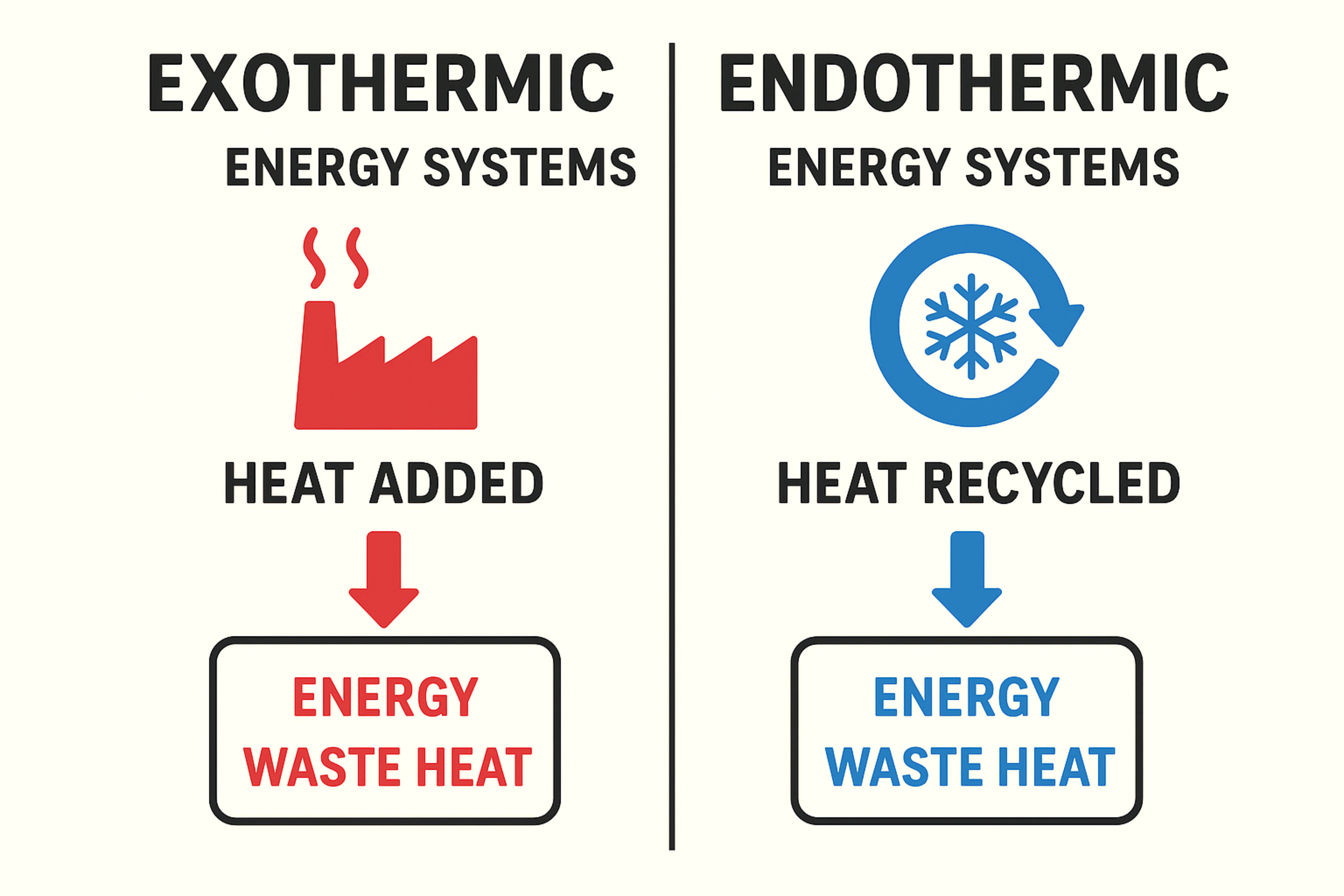
All exothermic energy sources—such as coal, oil, fission, or fusion—release heat into the environment. The main difference lies in how much heat and how quickly they do so. Fusion’s ideal efficiency (the portion of energy we can utilize) is around 40 to 50 percent, but in practical applications, losses from controlling plasma and converting energy reduce this to about 20 to 30 percent. Therefore, for every unit of useful energy produced, two or three units are expelled as waste heat. Unlike sunlight, which the Earth already manages, this additional heat accumulates over time.
Physicist Thomas Murphy estimates that the waste heat from all human energy use is about 10,000 times less than the energy the Earth receives from the Sun. That might seem insignificant. But if our energy consumption increases by just 2.3 percent each year—doubling every 30 years—our waste heat would equal today’s solar input in roughly 400 years. Even more concerning, it would match the additional 1 watt per square meter causing climate change in just 100 years. So, even if we stopped all greenhouse gas emissions and used only “clean” fusion, global temperatures would still rise—not from carbon, but from our own waste heat.
But there is another option. Not all energy needs to be exothermic. If we harness heat already present in the Earth—such as from the oceans, the air, or geothermal sources—the situation changes. In this case, the energy we use is recycled, not added to the planet’s total load. Since energy conversion is never perfect, about 30 percent of the captured heat would become waste heat, but this could be easily released back into space as the greenhouse effect lessens. This kind of “negative-emission energy” would actually cool the planet, providing an endothermic way to be sustainable.
This distinction—between adding new energy and utilizing existing energy—is crucial. Fusion, fission, and fossil fuels all deliver energy to the planet, increasing entropy and exacerbating the thermodynamic challenge. Endothermic systems, which draw energy from current heat sources, help address this issue. They enable us to power society while maintaining the planet’s thermal balance.
Yet our policy and research priorities remain focused on exothermic miracles. Fusion captures our imagination because it scales — it promises abundance without sacrifice. But abundance isn’t the same as balance. A truly sustainable energy future requires thinking about entropy management, not just reducing carbon. The goal must be to harvest the energy already trapped in Earth’s overheated climate system and send it back to space, not to produce more.
Fusion remains a prime example of human creativity and our ability to imitate the stars. However, as the world faces challenges with emissions and heat, it might be time to channel our skills into different pursuits: creating technologies that cool instead of heat, and that repair instead of worsening the problem. The science is solid, but the reasoning is straightforward.
The heat is on, both physically and metaphorically. Our future relies less on how well we can ignite new fires and more on how wisely we allow the old ones to fade away.